The Problem
43,108 devices published.
Zero tested like they'd fly.
Of every perovskite device in the field's own database, none was tested under vacuum and thermal cycling together. The instrument to do it has never been built.
Vacuum
Volatiles escape the crystal. Degradation accelerates up to 10×.
Thermal cycling
−150 °C to +120 °C every 90 minutes. Perovskites cross phase transitions inside that range, every orbit.
No standard, no data
No qualification standard. Testing done one sample at a time, by hand. The data to engineer survival doesn't exist.
The Approach
An autonomous lab for space-proof materials
Build the instrument
Stress-test 64 materials at once under vacuum, deep thermal cycling, and sunlight, with crystal structure, optics, electrical output, and outgassing monitored live.
Generate the dataset
Every run produces degradation data that exists nowhere else. AI learns what survives and picks what to test next.
Deliver the materials
Screening and qualification data first. Then space-stable, ultra-light perovskite cells.
The Road to Space Power
From instrument to orbit
Foundation
Dutch B.V. in the Noordwijk space ecosystem. Analysis services fund R&D; AEVI-1 in development; ESA BIC track underway.
The world's first dataset
First multi-sample vacuum + thermal-cycling campaigns. Screening partnerships with materials developers.
Space-stable solar
AI-guided discovery converges on compositions that endure orbit. Qualification data and cells for array integrators.
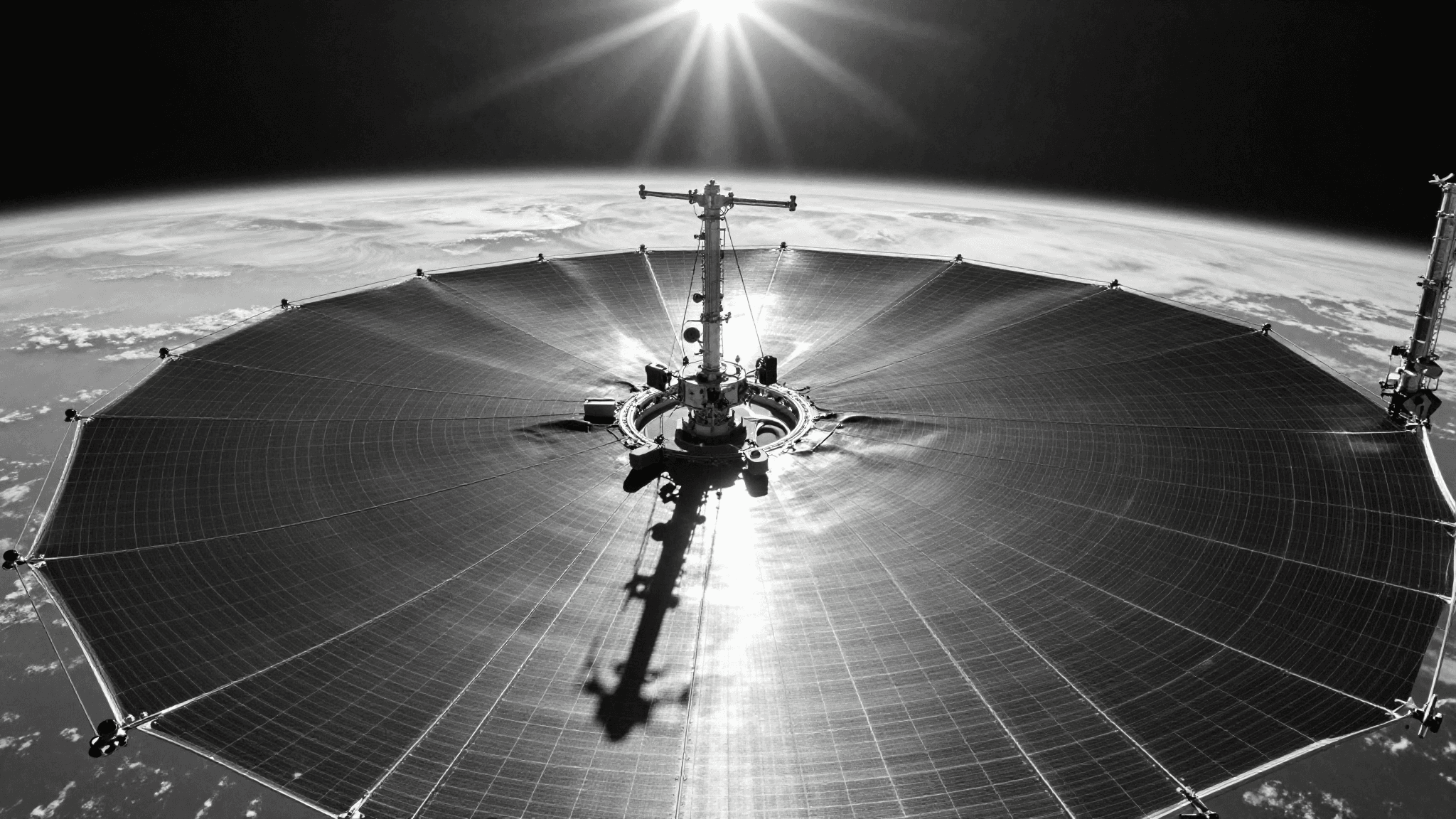
Powering solar power stations in space
Gigawatt-class space solar needs collectors far lighter and cheaper than anything flying. That supply chain doesn't exist. We intend to build it.